
Boost Your Bankroll with Two Exclusive Weekly Freerolls at BCPoker
14 Sep 2026Read More
The House Always Wins? Phenom Poker’s Pivot is a Lesson in Economic Gravity
- Phenom Poker switches from a fixed to a market-driven $PHNM token.
- The change aims to address previous treasury-draining issues.
- Risk and volatility rise as players are now also investors.
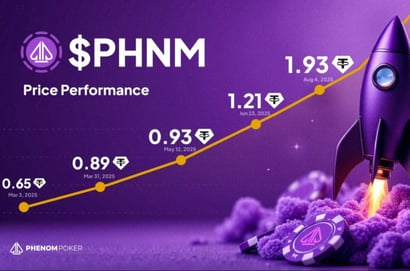
In crypto-gaming, "innovation" often comes across as a polite synonym for "fixing a broken economic model." Alec Torelli’s thread on Phenom Poker’s shift to a publicly traded $PHNM token is a masterclass in this specific brand of spin.
While Torelli framed the move as a revolutionary "Crypto IPO," the reality is much starker: Phenom is acknowledging that its previous model was unsustainable, and it's hoping its community will accept equity in place of stability.
The pivot is fascinating, risky, and, strictly from an economic standpoint, absolutely necessary.
The Death of the Fixed-Price Peg
Phenom’s update addresses a fundamental flaw in their original design. As Torelli himself said, the fixed-price token system was draining the treasury. By guaranteeing a buyback price, Phenom was essentially acting as a central bank defending a currency peg. When players cashed out, the treasury bled.
This stifled growth because capital that should have been used for marketing and acquisition was instead held hostage to ensure liquidity for exits. In traditional finance, this is a death spiral. By moving to a floating token model, Phenom is obeying the laws of economic gravity.
The "IPO" Narrative vs. The Reality
Torelli’s comparison of the new model to a traditional IPO is apt, but revealed more than it maybe intended to. By transitioning $PHNM to a free-market asset, Phenom is converting its player base from customers into speculators.
The new value proposition is a classic dividend model.
- The Upside: If Phenom becomes the next GGPoker, early holders of $PHNM become wealthy. The alignment of incentives is powerful; players now literally own a piece of the rake they generate.
- The Downside: Volatility. Poker players are used to variance at the tables, not in their bankrolls. If the token price tanks due to low volume or market sentiment, the effective rakeback (even at the touted 39% for lockers) evaporates.
The Trust Gap
The elephant in the room, which the community has rightly fixated on, is the transition period. Freezing redemptions, even if temporary and logically necessary to prevent a run on the bank before the liquidity pool is established is the cardinal sin of crypto.
For a project touting "decentralized ownership," the unilateral decision to freeze funds and alter the fundamental contract of the ecosystem highlights a centralized point of failure. The lack of player voting on such a monumental shift contradicts the ethos of Web3.
The Verdict
Alec Torelli is right about one thing: The old model was broken. A poker site cannot grow if its treasury is merely an exit liquidity facility.
However, this "IPO" is a gamble. Phenom is betting that the promise of long-term equity and high-yield rakeback will outweigh the short-term sting of frozen funds and price volatility. They are asking players to stop looking at their balance as cash-on-hand and start viewing it as a stock portfolio.
If the token appreciates, this will be remembered as the moment Phenom matured into a legitimate business. If the market rejects the valuation, players will realize that in this specific game of poker, they were holding the bag, not the cards.
Key Takeaways for the Investor-Player
| Feature | Old model (Fixed) | New Model (Floating) |
|---|---|---|
| Token Value | Artificial/Pegged | Market Driven |
| Risk Profile | Low (until treasury failure) | High (Market volatility) |
| Primary Incentive | Stability | Revenue Share & Growth |
| Sustainability | Low (Drains Treasury) | High (Protects Treasury) |
Upcoming Events
19 September 2026
European Mixed Poker Championship 2026 Poker
Tallinn to Host Inaugural European Mixed Poker Championship 2026 This October
Battle of Malta Autumn Edition 2026 Poker
What to Expect from the Battle of Malta October 2026 Autumn Edition
APT Championship Taipei 2026 Poker
APT Championship Taipei 2026 Set to Ignite Asia Poker Arena with TWD 165M GTD Main Event
30 October 2026
Poker EventsStarts in
Latest News
-
 Freeroll
 -
WPT Australia 2026September in Sydney: Everything You Need to Know About WPT Australia 202621 May 2026Read More
-
Unibet Open MarrakechMoroccan Autumn: Unibet Open Marrakech 2026 Announces 11-Day Schedule14 Jul 2026Read More
-
Jeju eventAsian Poker Tour Announces Ten-Day APT Jeju 2026 Festival at LES A Casino02 Jun 2026Read More
-
$125K GTDStake Showdown Set for September 27 With $125,000 Guarantee10 Sep 2026Read More